For the past few years, I’ve had a growing sense that the quality of food has been declining. Meat, fruit, vegetables—nothing catastrophic, nothing you could point to in a single moment. Just a gradual shift. Slow enough that it would be easy to dismiss if you weren’t paying attention. I’ve always been good at noticing patterns, and this felt like one. Like boiling a frog slowly. There was no headline for it, just accumulation.
About a year ago, in the middle of an unrelated and still-unresolved legal situation that materially limits what I can do, I began to feel a deep internal pull toward living off the land. Off grid. Not as a lifestyle experiment, but as something closer to responsibility. I didn’t have a plan for it. It wasn’t practical. It didn’t line up with where my life was at the time.
Not long after that, my wife told me she’d had a dream and a vision—independently—about living off the land and raising livestock. When she told me, I remember thinking that we had somehow received the same memo. Since then, we’ve been praying for alignment and discernment around what this actually means. Not clarity in the abstract, but clarity about what we’re supposed to do now, given that so much is still constrained.
Out of that process came a name: Restore Creation.
At its core, Restore Creation is a regenerative agriculture vision rooted in stewardship, restoration, and long-term faithfulness rather than extraction or short-term yield. It’s an attempt to rebuild land, systems, and community by working with creation instead of against it.
The working vision integrates a tropical food forest, rotationally grazed livestock, and aquaculture into a single, closed-loop ecosystem. The goal is to minimize—and eventually eliminate—external inputs while improving soil health, water quality, biodiversity, and food resilience over time.
The land, as I imagine it, isn’t something to be optimized like a balance sheet. It’s a living system to be healed. Animals aren’t isolated production units; they’re participants in regeneration—fertilizing soil, cycling nutrients, shaping pasture. Water isn’t drained away; it’s captured, filtered, reused, and returned cleaner than it arrived. Trees are planted not only for harvest, but for shade, wind protection, microclimates, and long-term stability.
The intended system includes livestock—cows, pigs, chickens, sheep—alongside fish suited for two half-acre ponds: bluegill, bass, catfish, whatever fits the ecology. There would be a food forest growing everything possible in the zone, a vegetable garden doing the same, and ponds with swales that feed the food forest and cycle nutrients back again. The aspiration is to grow all animal feed on the land, have fish feed within the system, and rely on biological processes rather than fertilizers, pesticides, pharmaceuticals, or veterinary intervention. Not as a guarantee, but as a north star—trusting that God’s design is more coherent than anything we could engineer on our own.
Restore Creation is intentionally small, local, and relational. The goal isn’t industrial scale. It’s what I think of as faithful scale: producing nutrient-dense food for a nearby community through a subscription model that connects people directly to the land that feeds them. People wouldn’t be buying products so much as participating in restoration.
The rough idea is a weekly delivery service to the Lakewood Ranch, Florida area, serving people who are willing to pay a premium for exceptionally healthy, locally produced food. The core of the subscription would be animal protein—beef, pork, lamb, chicken, eggs, fish—delivered in whatever combination the land provides that week. One week it might be chicken and fish, another week mostly beef. Alongside that, there would be random seasonal fruits and vegetables as a bonus. You get what you get. The assumption is a weekly subscription model priced to sustain the land and the work. We would cap membership based on what the land can actually support—maybe 20 or 30 households, maybe fewer. That number won’t be known until the land exists.
The intent isn’t profit maximization. It’s to finance the operation sustainably—without stress, without burnout—while feeding our own family, feeding the land, feeding livestock, donating food where possible, and creating opportunities for people to work. Members wouldn’t just be customers; they’d be part of a community. We imagine shared meals, gatherings on the land, and a relationship that’s closer than a transaction.
Underlying all of this is a theological conviction I’m still learning how to live into: creation was called “very good,” and humanity’s role was never maximum output. It was care. Tending. Passing on land that’s healthier than when we received it.
That conviction also shows up in how we’re thinking about seeds. In modern agriculture, it’s common to grow rootstock and graft for speed and predictability. It makes sense if efficiency is the goal. But I keep wondering what happens if you grow everything from seed instead—accepting variability, feeding bad fruit to animals, composting what doesn’t work, and trusting that something unexpected and good might emerge. It shifts control away from certainty and toward provision.
At the same time, I’m very aware of what I don’t know. Neither my wife nor I have any formal experience in agriculture. We’re learning as we go. And because of the ongoing legal matter, we’re not in a position to buy land yet. That limitation is active and unresolved.
So, this season looks like waiting—but not idleness.
We’re researching land in Myakka City, Hardee County, DeSoto County, and surrounding areas. We’re studying livestock systems, food forests, and water management. I’m sketching rough layouts of what buildings might be needed and where we might live in relation to them. In our current small yard, I’m treating things like a research and development lab—starting plants in trays, learning through failure, growing oak trees from acorns for shade and privacy, fruit trees from seed, tomatoes, cucumbers. Not because this will scale, but because learning now means less wasted time later.
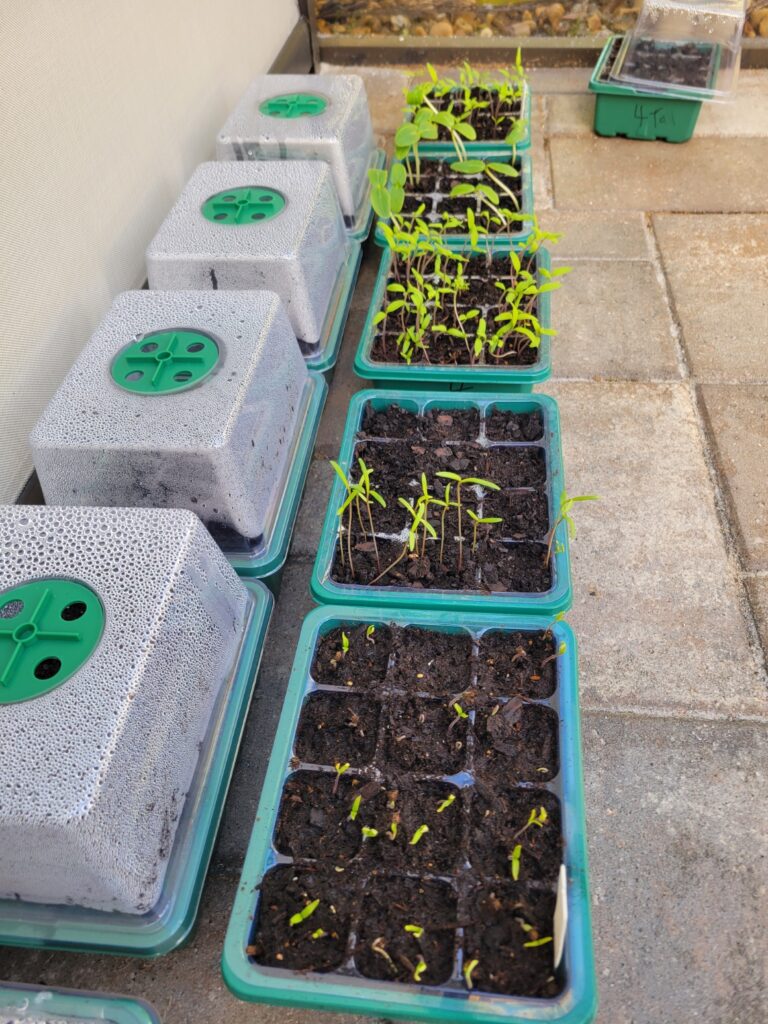
Restore Creation doesn’t exist yet as land or infrastructure. It exists as preparation, intention, and restraint. A long obedience in the same direction. Patient work. Unseen progress. Trust that faithful systems—like faithful people—bear fruit in time.
This is the beginning of that record.